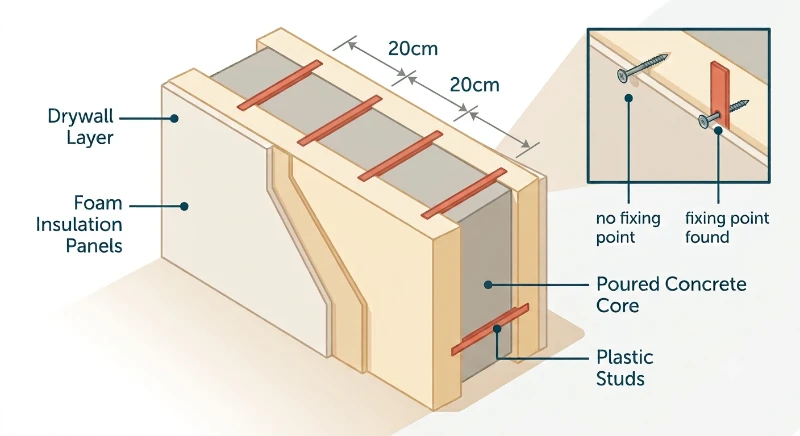
Houses in Hawk's Bay have their outer walls built from ICF — Insulated Concrete Forms. In plain terms, it's a hollow foam block that gets stacked up like Lego and then filled with poured concrete, leaving a solid concrete core sandwiched between two layers of rigid foam insulation, with drywall fixed to the inside face. It's a great, well-insulated way to build a house — but it causes one very specific headache when you want to hang a shelf, a TV bracket, or anything heavier than a picture hook: a standard stud finder is useless on it.
Internal partition walls (the ones dividing rooms inside the house) are ordinary hollow/stud construction, so a normal magnetic or electronic stud finder works fine on those. It's only the outer walls — where the ICF is — that need a different approach.
Why a normal stud finder doesn't work
Inside every ICF block, the two foam faces are held apart and together by a series of plastic cross-ties (sometimes called webs or furring strips), embedded in the foam and running the full height of the wall. These plastic strips are what the drywall is actually screwed into — everywhere else, behind the drywall is just rigid foam and, further back, solid concrete.
The problem is that a stud finder works by detecting density changes (edge-sensing) or metal (magnetic types, picking up screw heads). A thin strip of plastic embedded in foam, behind a layer of drywall, doesn't give a normal stud finder enough of a signal to reliably find — so it either finds nothing or gives false positives. This is a well-known issue for anyone building or living in an ICF house, not something specific to Hawk's Bay.
The nail test
This is the simplest and most reliable method, and it doesn't need any special tools:
- Get a thin nail, at least 4.5cm (45mm) long — long enough to get through the plasterboard and into the foam behind it.
- Hammer it in gently at the point you want to check (a random spot, or exactly where you're planning to put a shelf or bracket).
- Read the result:
- If the nail goes in cleanly with little resistance, you've hit foam — there's no fixing point there.
- If the nail meets resistance and stands proud by a few millimetres, like it's hit something solid, you've found the plastic web.
- Double-check by tapping in one or two more nails about 1cm to either side of the first. This confirms you've hit the middle of the web rather than just clipping its edge — which matters if you're about to drill or screw into it properly.
- Map the rest from there. Once you've located one web, in Hawk's Bay houses the others run roughly 20cm apart, so you can measure along from your first find rather than testing the whole wall blind. Manufacturers vary this spacing (commonly 15–20cm), so treat 20cm as a good estimate for our houses specifically and confirm with a nail before drilling for anything heavy.
An alternative worth trying
Some residents have had luck running a strong magnet slowly across the wall instead of using a nail. Drywall on ICF is screwed (not nailed) directly into the plastic webs during construction, so a magnet can sometimes pick up the buried screw heads and show you where the webs are without making any new holes at all. It doesn't always work as reliably as the nail test, but it's worth trying first if you'd rather avoid marking the wall.
A few practical tips
- Plan before you test — decide roughly where you want your shelf or bracket first, then nail-test around that area rather than the whole wall.
- Patch as you go — a small nail hole is easy to fill with a dab of filler and touch-up paint before it's even noticeable.
- For anything heavy (a TV bracket, a full shelving unit), always confirm with the 1cm double-check before drilling — missing the web and drilling into bare foam won't hold real weight, no matter how deep the screw goes.
- Look up how ICF construction works if you want the full picture — searching "ICF insulated concrete forms" will show you diagrams of the block, the foam layers and the webs, which makes the nail test much more intuitive once you can picture what's behind the drywall.
Compiled from general ICF construction information and a technique tested by residents in their own Hawk's Bay homes — if you've found a method that works even better, let a committee member know so we can update this page.